

Best Probiotic for Dogs: The Short Answer
The best probiotic for dogs is a multi-strain formula that pairs live bacteria with prebiotics and digestive enzymes, survives stomach acid, and is dosed by body weight. In India, JOLLY GUT® fits this brief with 5 strains, 800 million CFU, prebiotics and 7 enzymes for roughly ₹899.
- What should I look for in a dog probiotic?
- Multiple bacterial strains, a stated CFU count, prebiotics to feed the bacteria, and ideally digestive enzymes. Strains shown to survive digestion matter more than a huge CFU number alone.
- When do dogs actually need a probiotic?
- During or after antibiotics, diarrhoea, diet changes, travel or boarding stress, and for ongoing gut and immune support. Probiotics support a healthy microbial balance (AKC, 2026).
- Which is best for an Indian dog?
- A shelf-stable powder you dose by weight handles Indian heat and humidity better than chews that soften. JOLLY GUT® is formulated for this and needs no refrigeration.
Best Probiotic for Dogs in India: How to Choose, and Our Top Picks
A healthy gut underpins almost everything you want for your dog: firm stool, a shiny coat, steady energy, and a robust immune system. Most of a dog's immune activity sits in the gut, so when the microbiome is disrupted by stress, illness or medication, the effects show up well beyond the stomach. The right probiotic helps restore that balance.
This guide does two things. First, it explains how to actually choose a dog probiotic, the strains, CFU count, prebiotics and enzymes that matter, when to use one, and what it should cost in India. Then it reviews seven probiotics you can buy for Indian dogs, with our hero pick, JOLLY GUT®, leading the list. Dosing and clinical notes here are reviewed by Dr. Manveen Kaur (BVSc & AH), Veterinary Consultant at Unleash Wellness.
How to Choose a Probiotic for Your Dog
Before comparing brands, understand the four things that separate a working probiotic from a waste of money.
- Strains, not just "probiotics": Different bacterial species do different jobs. Strains commonly found in canine probiotics include Lactobacillus acidophilus, Enterococcus faecium, Bifidobacterium species and the beneficial yeast Saccharomyces boulardii (AKC, 2026). A multi-strain blend covers more ground than a single strain.
- CFU count (colony forming units): This is the number of live organisms per dose. A stated, guaranteed count matters more than a giant headline number, because many cheap formulas lose viability before the bacteria reach the gut.
- Prebiotics: Fibres such as fructo-oligosaccharides (FOS) and mannan-oligosaccharides (MOS) feed the good bacteria once they arrive. A probiotic plus a prebiotic is called a synbiotic, and synbiotics are the form most studied in dogs.
- Digestive enzymes: Enzymes like protease, lipase and amylase help break down food, which eases bloating and improves nutrient absorption alongside the bacteria.
One practical India note: format matters in our climate. Soft chews can melt or go sticky in summer heat, and some need refrigeration once opened. A shelf-stable powder you mix into food is usually the more reliable choice for Indian homes.
When Does a Dog Actually Need a Probiotic?
Probiotics are most useful when the gut's microbial balance is under pressure rather than as a cure-all. Common triggers where a vet may suggest one include diarrhoea or gas, diet changes, eating spoiled food, old age, parasites, and medications such as antibiotics or long-term steroids that kill off good bacteria (AKC, 2026).
Stress is a big one for Indian pet parents. Boarding, travel, festival noise and house moves can all upset a dog's stomach, and the AKC notes it can make sense to start a probiotic a few days ahead of a known stressful event. There is also clinical support for acute cases: in a randomised, double-blind trial of dogs with sudden gastroenteritis, the probiotic group's diarrhoea resolved in a mean of 1.3 days versus 2.2 days for placebo (Herstad et al., 2010). For antibiotic-related upset, a synbiotic has been shown to help maintain food intake and stool quality in dogs given antibiotics (Whittemore et al., 2019).
Conditions Probiotics Can Help With
Probiotics support, rather than replace, veterinary treatment for these common issues:
- Diarrhoea and loose stool: The best-evidenced use. Probiotics can shorten the duration of acute, self-limiting diarrhoea (Herstad et al., 2010).
- Antibiotic recovery: Antibiotics flatten the microbiome; a synbiotic helps protect appetite and stool quality during treatment (Whittemore et al., 2019).
- Gas, bloating and bad breath: Often signs of microbial imbalance that probiotics and enzymes can ease.
- Itching and dull coat: Gut health and skin are linked; many pet parents notice coat and itch improvements once digestion settles.
- Stress-related tummy upset: Useful around travel, boarding and routine changes.
Probiotics are not a treatment for serious disease. Persistent vomiting, blood in stool, or diarrhoea lasting more than 24 to 48 hours needs a vet, not a supplement.
1. JOLLY GUT® by Unleash Wellness (Best Overall for Indian Dogs)
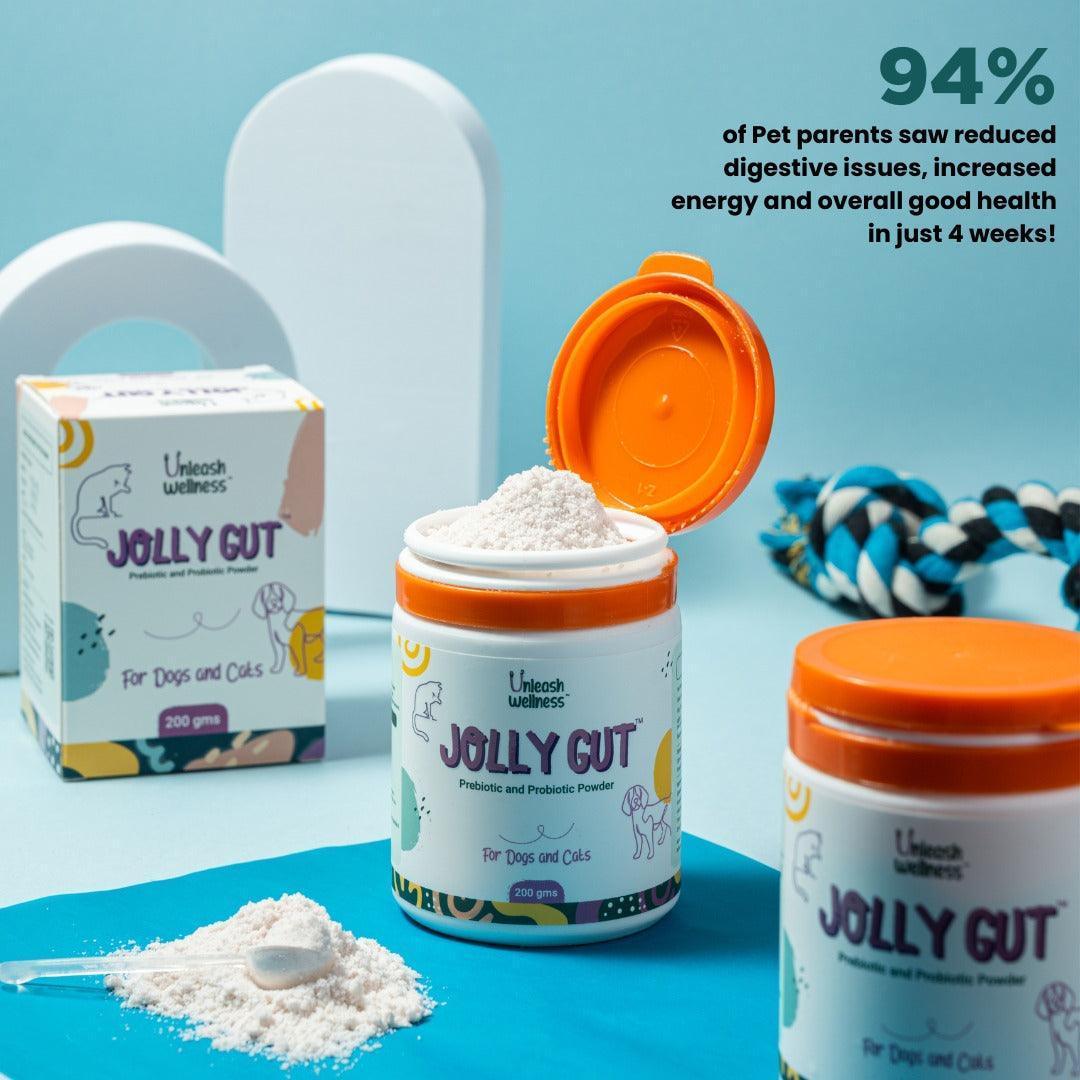
JOLLY GUT® is a pre + probiotic powder built specifically for Indian dogs and cats. It is the pick that best matches the buying checklist above: it is multi-strain, lists its CFU count, includes prebiotics and enzymes, is shelf-stable, and is dosed by body weight rather than guesswork.
Per the live product page, each gram delivers 5 scientifically selected probiotic strains at 800 million CFU (Saccharomyces cerevisiae, S. boulardii, Lactobacillus acidophilus, L. casei and L. rhamnosus), plus prebiotics (fructo-oligosaccharides and mannan-oligosaccharide), a 7-enzyme digestive complex (protease, lipase, amylase, beta-glucanase, cellulase, hemicellulase, pectinase), liver extract, zinc and sodium bicarbonate. It is free from artificial colours, synthetic preservatives and added sugars. This synbiotic-plus-enzyme design is exactly the multi-component form best studied in dogs (Whittemore et al., 2019).
Pros:
- Complete synbiotic formula: probiotics, prebiotics and enzymes in one powder, not just bacteria.
- Dosed by weight: a simple weight chart (up to 10 kg, 10–20 kg, 20–40 kg, over 40 kg) instead of one-size-fits-all.
- Shelf-stable: no refrigeration, which suits Indian heat and travel.
- Built for India: formula reviewed by Dr. Manveen Kaur (BVSc & AH), third-party tested, 233+ reviews.
- Easy to give: a near-tasteless powder (1 scoop ≈ 2 g) that blends into wet or dry food.
Cons:
- Daily use needed: like all probiotics, results build with consistent use.
- Powder measuring: requires scooping rather than a pre-dosed chew.
- Short adjustment period: some dogs have a brief change in stool as gut flora rebalance.
Price & sizes: from ₹899 (typical list ₹999) for a 200 g bottle, with 45, 90 and 180-day packs. Free shipping over ₹500. Buy: JOLLY GUT®.
2. Purina Pro Plan FortiFlora
FortiFlora is a widely vet-recommended probiotic that uses a single patented strain, Enterococcus faecium SF68, in single-serve liver-flavoured packets. It is a reliable, palatable option for diarrhoea, digestive upset and antibiotic recovery, and the pre-portioned sachets make dosing foolproof.
- Best for: picky eaters and short-term digestive upset where a tasty, single-dose sachet is convenient.
- Trade-offs: single strain only, contains animal digest, and tends to be priced at a premium in India.
3. Zesty Paws Probiotic Bites
These pumpkin-flavoured soft chews pack six probiotic strains at around 3 billion CFU per chew, with the prebiotic inulin and added digestive enzymes. The chew format is easy to give as a treat.
- Best for: dogs who take treats readily and owners who prefer a chew over a powder.
- Trade-offs: chews can soften in Indian summers, and the added ingredients can bother sensitive dogs. Imported pricing and availability vary.
4. Nom Nom Probiotic Support
A premium, vet-nutritionist-developed powder using seven canine-relevant strains at a high 20 billion CFU per serving, plus prebiotic fibre. Clean ingredient list and easy to mix into food.
- Best for: owners wanting a high-CFU, canine-specific powder and willing to pay for it.
- Trade-offs: premium price, refrigeration recommended after opening, and limited direct availability in India.
5. The Honest Kitchen Daily Boosters (Goat's Milk)
A whole-food take on probiotics, built on dehydrated goat's milk with added Lactobacillus acidophilus and Bacillus coagulans. Palatable as a food topper or drink.
- Best for: owners who prefer minimally processed, food-based supplements.
- Trade-offs: needs reconstituting before use, contains lactose (not ideal for all dogs), and has a short shelf life once mixed.
6. PetLab Co. Probiotic Chews
Duck-flavoured soft chews combining six strains (about 3 billion CFU), FOS prebiotics, digestive enzymes and pumpkin fibre. A complete, palatable all-in-one chew.
- Best for: dogs of any size who like a flavoured chew and need broad gut support.
- Trade-offs: higher price point, chew consistency suffers in heat, and possible ingredient sensitivities..
7. Nusentia Probiotic Miracle
A high-potency, tasteless powder with six strains and FOS prebiotics, totalling a very high 360 billion CFU per jar. Made in the USA in a GMP-certified facility with a long shelf life and no fillers.
- Best for: picky eaters and owners wanting a clean, high-CFU powder with economical cost per serving.
- Trade-offs: small doses need precise measuring, and the lack of flavour does not entice every dog..
Quick Comparison: 7 Dog Probiotics at a Glance
| Product | Strains / CFU | Format | Prebiotic + enzymes | India availability / price |
|---|---|---|---|---|
| JOLLY GUT® | 5 strains / 800M CFU per g | Powder, dosed by weight | Yes + 7 enzymes | Made in India, from ₹899 |
| Purina FortiFlora | 1 strain (E. faecium SF68) | Sachet powder | No | Available, premium |
| Zesty Paws Bites | 6 strains / ~3B CFU | Soft chew | Yes (inulin) + enzymes | Imported, varies |
| Nom Nom | 7 strains / 20B CFU | Powder (refrigerate) | Yes (fibre) | Limited in India, premium |
| Honest Kitchen | Goat's milk + 2 strains | Reconstituted powder | Natural enzymes | Imported, varies |
| PetLab Co. Chews | 6 strains / ~3B CFU | Soft chew | Yes (FOS) + enzymes | Imported, premium |
| Nusentia | 6 strains / 360B CFU per jar | Tasteless powder | Yes (FOS) | Imported, varies |
CFU values are as stated by each manufacturer and are measured differently (per gram, per serving or per jar), so they are not directly comparable. Always confirm current price and availability with the retailer.
Probiotic Dosing for Dogs by Weight
Probiotics are dosed by body weight, and the exact amount depends on the product, so always follow the label. As a practical India reference, the table below shows how JOLLY GUT® scales (1 scoop ≈ 2 g, given once in the morning and once in the evening). Dosing reviewed by Dr. Manveen Kaur (BVSc & AH).
| Dog weight | Daily approach | Example breeds (India) |
|---|---|---|
| Up to 10 kg | Smallest weight band, split AM/PM | Shih Tzu, Pug, Indian Spitz, Chihuahua |
| 10 – 20 kg | Mid band, split AM/PM | Beagle, small Indie dogs |
| 20 – 40 kg | Higher band, split AM/PM | Labrador, Golden Retriever |
| Over 40 kg | Largest band, split AM/PM | German Shepherd, Rottweiler, Husky |
Start at the lower end and build up over a few days, watching for any loose stool. Mix the powder into wet food or a little curd-free broth for fussy eaters. Give consistently; most gut benefits build over several weeks.
Side Effects: Are Probiotics Safe for Dogs?
Probiotics are considered very safe for healthy dogs, and serious side effects are uncommon. When mild issues occur they are usually digestive and settle with a lower dose. Watch for these, especially in the first week:
- Temporary soft stool or gas as the gut flora rebalance. Reduce the dose and build up more slowly.
- Reaction to flavourings or added ingredients in flavoured chews. Prefer a clean, minimally flavoured formula for sensitive dogs.
- No clear benefit: not every dog needs a probiotic. If you see nothing after 4–6 weeks, reassess with your vet.
Caution is warranted for puppies, very old dogs, or any dog that is immunocompromised or seriously ill, talk to your vet first. Stop and seek veterinary care for persistent vomiting, blood in stool, or diarrhoea lasting beyond 24 to 48 hours; a probiotic does not treat serious gastrointestinal disease.
Probiotic Supplement vs Curd and Homemade Options
Many Indian pet parents reach for curd (dahi), buttermilk or fermented foods first. These can offer some live cultures, but they are unreliable as a dog probiotic. Curd typically supplies only one or two strains at unpredictable counts, carries a high lactose load that many adult dogs tolerate poorly, and adds meaningful calories: matching a supplement's probiotic concentration could mean feeding several cups of curd daily.
Plain yogurt or kefir with live cultures can be a small, occasional addition for dogs that tolerate dairy, but read labels and avoid anything with sugar or artificial sweeteners, especially xylitol, which is toxic to dogs (AKC, 2026). For consistent, lactose-free, multi-strain support with a known dose, a purpose-built supplement like JOLLY GUT® is the more dependable choice.
Frequently Asked Questions
What is the very best probiotic for dogs?
The best probiotic is a multi-strain synbiotic that lists its CFU count, includes prebiotics, survives stomach acid, and is dosed by weight, rather than a single-strain product chosen on price. For Indian dogs, JOLLY GUT® fits this with 5 strains, 800 million CFU, prebiotics and 7 digestive enzymes in a shelf-stable powder.
Are there good probiotics for dogs?
Yes. Dog-specific probiotics use strains normally found in the canine gut, such as Lactobacillus and Enterococcus species, and are recommended by vets to support a healthy microbial balance, especially around diarrhoea, antibiotics and stress (AKC, 2026). Choose a product formulated for dogs rather than a human supplement.
Is pumpkin a probiotic?
No. Plain cooked pumpkin is not a probiotic, it is a source of soluble fibre that acts more like a prebiotic and a stool firmer. It can complement a probiotic for loose stool, but it does not supply live beneficial bacteria, so it does not replace a proper dog probiotic.
Which prebiotic is best for dogs?
Fructo-oligosaccharides (FOS) and mannan-oligosaccharides (MOS) are the prebiotics most used in canine formulas, and they work best paired with probiotics as a synbiotic. JOLLY GUT® combines both FOS and MOS with its live strains, so you do not have to add a prebiotic separately.
What is the best probiotic for dogs with diarrhoea?
For sudden, self-limiting diarrhoea, a multi-strain probiotic can shorten recovery; in one trial diarrhoea resolved in about 1.3 days with a probiotic versus 2.2 days with placebo (Herstad et al., 2010). Use it alongside a bland diet and see a vet if diarrhoea lasts beyond 24 to 48 hours or contains blood.
Are probiotics good for dogs in India specifically?
Yes, and format matters here. Heat and humidity can soften chews and some powders need refrigeration, so a shelf-stable, weight-dosed powder is usually more reliable for Indian homes. JOLLY GUT® is formulated for Indian conditions, needs no refrigeration, and costs from around ₹899.
The Bottom Line
The best probiotic for your dog is the one that matches the checklist: multiple strains, a stated CFU count, prebiotics, ideally enzymes, a format that survives your climate, and a dose set by your dog's weight. Several products here meet parts of that brief, but for Indian pet parents wanting a complete, shelf-stable, weight-dosed synbiotic at a fair price, JOLLY GUT® is our top overall pick. Whichever you choose, introduce it gradually and check with your vet if your dog has an ongoing health condition or is on medication.
Reviewed for Indian dietary and climate conditions by Dr. Manveen Kaur (BVSc & AH), Veterinary Consultant at Unleash Wellness.
Sources & References
Reviewed by Dr. Manveen Kaur (BVSc & AH), Veterinary Consultant at Unleash Wellness. Health claims in this article are supported by the following sources:
- American Kennel Club. Probiotics for Dogs (Updated 2026). akc.org
- Whittemore, J.C. et al. Randomized, controlled, crossover trial of prevention of antibiotic-induced gastrointestinal signs using a synbiotic mixture in healthy research dogs. Journal of Veterinary Internal Medicine (2019). PMC6639531
- Herstad, H.K. et al. Effects of a probiotic intervention in acute canine gastroenteritis, a controlled clinical trial. Journal of Small Animal Practice (2010). PubMed 20137007


